Capture the context
Keep the source and customer needs together so the next colleague can continue the conversation without starting again.
Industry solutions
Explore how the three CX Suite products — LeadMe, SurveyMe and CaseMe — support this industry, with use cases, workflows, responsibilities and measures.
Explore all three products ↓
Illustrative operating examples, not client results or a promised return.
A shopper asks at night whether an appliance is available, what it costs and when it could be delivered. Capture the item, preferred store and delivery area. Use approved product information and route stock or delivery confirmation to the responsible team. The store receives the customer's context before the visit, while management can connect the enquiry source to the recorded sales outcome.
Furniture, electronics and specialist retailers can qualify requests for demonstrations, measurements or installation. Keep reservations distinct from confirmed stock allocations. Any automated price, stock or delivery promise depends on an approved, connected source of current information.
Explore LeadMe in detailKeep the source and customer needs together so the next colleague can continue the conversation without starting again.
Assign a responsible colleague, agree the follow-up and confirm availability before committing to an appointment. Connected calendars and messaging are configured for the agreed rollout.
Record attendance and the eventual decision. Separate enquiries, requests and confirmed outcomes so management can see where opportunities stop progressing.
Product requested; store; delivery area; visit preference; enquiry source; assigned colleague
Store sales team or central customer service
Response time, qualified requests, store appointments, follow-up completion and recorded conversion by branch
Start with your own baseline and compare like-for-like periods after rollout. Use confirmed activity and outcomes to assess performance; illustrative examples are not guaranteed results.
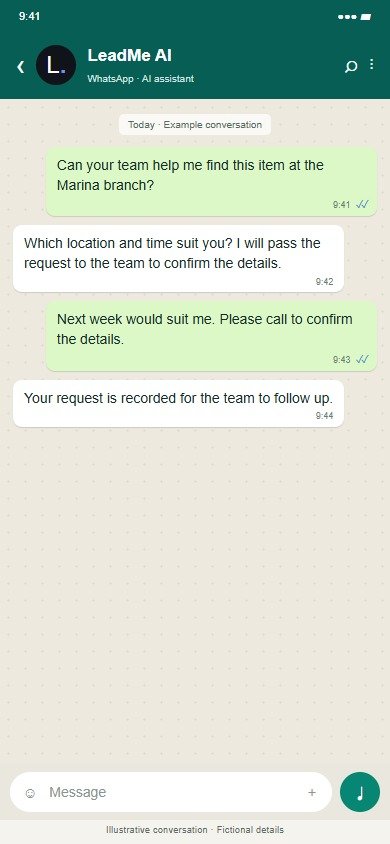
Illustrative conversation with fictional details; wording and connections are agreed before rollout.
Illustrative operating examples, not client results or a promised return.
An electronics chain invites customers who agreed to contact to comment after purchase. Customers with delivery and installation receive feedback questions at the relevant completed stage. Store service and logistics are reported separately, so a late installer is not hidden inside a single branch average. Managers can read the comments behind low scores before deciding what to change.
Compare stores on staff help, product explanation, checkout and aftercare. A regional review can examine whether a recurring complaint belongs to a particular store or a shared delivery process. Show the response count and survey stage alongside each comparison, rather than treating different customer journeys as interchangeable.
Explore SurveyMe in detailAgree the contact permission, event and timing for the invitation. Use a consistent question set for each journey and avoid mixing unrelated experiences in one score.
Review scores with response volumes and the comments behind them. Compare equivalent branches, stages and periods, then identify themes that the team can act on.
Agree which feedback needs a callback and who owns it. Where a CaseMe connection is configured, keep the response and service-recovery outcome linked to the concern.
Store; purchase or delivery stage; service ratings; response date; customer comment
Retail operations or customer experience manager
Participation, store satisfaction, delivery and installation scores, repeat themes and changes by reporting period
Start with your own baseline and compare like-for-like periods after rollout. Use confirmed activity and outcomes to assess performance; illustrative examples are not guaranteed results.
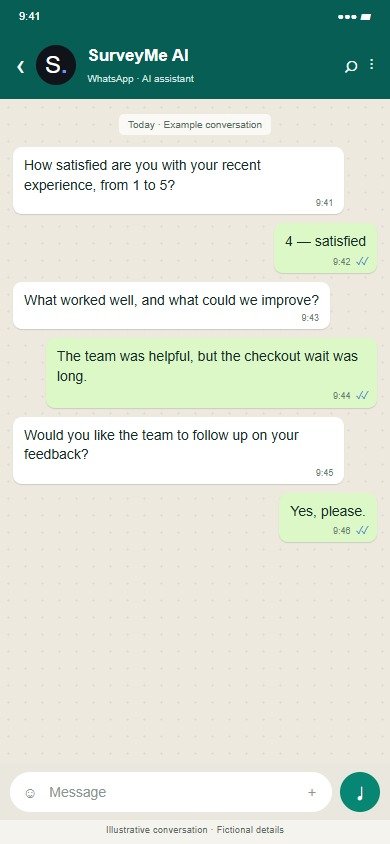
Illustrative conversation with fictional details; wording and connections are agreed before rollout.
Illustrative operating examples, not client results or a promised return.
An appliance installation is late and the customer asks for help. The case is categorised as delivery or installation and assigned to the logistics supervisor. A replacement appointment, customer callback and any authorised goodwill action are recorded as next steps. The store can see progress without making the customer repeat the issue to another department.
Returns, damaged deliveries and warranty-service concerns can follow different owners and response targets. The final record should say what was agreed and completed, not simply that someone sent a message. Recurring categories help the regional team identify supplier, delivery or store-process problems.
Explore CaseMe in detailCapture the service issue and relevant reference, then categorise it so it reaches the right team. Use approved systems for sensitive supporting records.
Set a named owner, next action and due date. Define who reviews overdue work and how escalation should operate for this service, rather than leaving responsibility in a shared inbox.
Record what was done, the customer update and any remaining follow-up. Review repeat causes and case age so the team can improve the underlying service as well as respond to individuals.
Order reference; store; delivery or product issue; owner; next appointment; approved action; outcome
Store manager or logistics supervisor according to the issue
Open cases by store and category, overdue actions, repeat delivery issues, time to resolution and documented outcomes
Start with your own baseline and compare like-for-like periods after rollout. Use confirmed activity and outcomes to assess performance; illustrative examples are not guaranteed results.
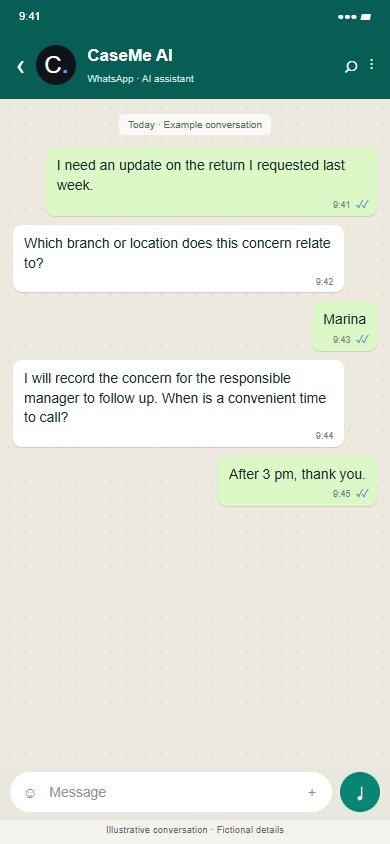
Illustrative conversation with fictional details; wording and connections are agreed before rollout.
Start with one agreed journey, its responsible team, data sources, permissions and follow-up targets. Calendar, CRM and operational-system connections, and WhatsApp or voice channels, are scoped before live use. The public demo is for exploration with fictional data.
Group Pro: $300/month platform fee plus $149/location for 10–24 locations.